Infrastructure comparison
Air Cooling vs. Liquid Cooling for Data-Center Loads
Reviewed by Enzo Parilli · Updated 2026-08-02 · Editorial policy
Direct answer
When should a data center evaluate liquid cooling?
Liquid cooling becomes more relevant as rack heat density, accelerator deployment, or facility constraints exceed what the existing air path can manage. It introduces its own distribution, fluid, service, leak-management, and qualification requirements; it is not a universal replacement for air cooling.
At-a-glance comparison
| Dimension | Option A | Option B |
|---|---|---|
| Heat path | Airflow and heat-exchanger infrastructure | Fluid loop, CDU, manifold, and facility integration |
| Strength | Familiar service and broad ecosystem | Higher-density heat transfer potential |
| RFQ risk | Rack density and airflow balance | Fluid, leak management, service, and facility compatibility |
Option labels summarize the comparison topic; the full engineering and procurement requirement controls the final decision.
System trade-offs
- Air: familiar service model and broad equipment ecosystem, with limits at higher heat density.
- Liquid: closer heat transfer and higher-density potential, with CDU, manifolds, fluid, service, and facility integration requirements.
Procurement implications
- Define rack density, supply and return temperatures, CDU requirements, facility water, leak detection, maintenance, and replacement strategy.
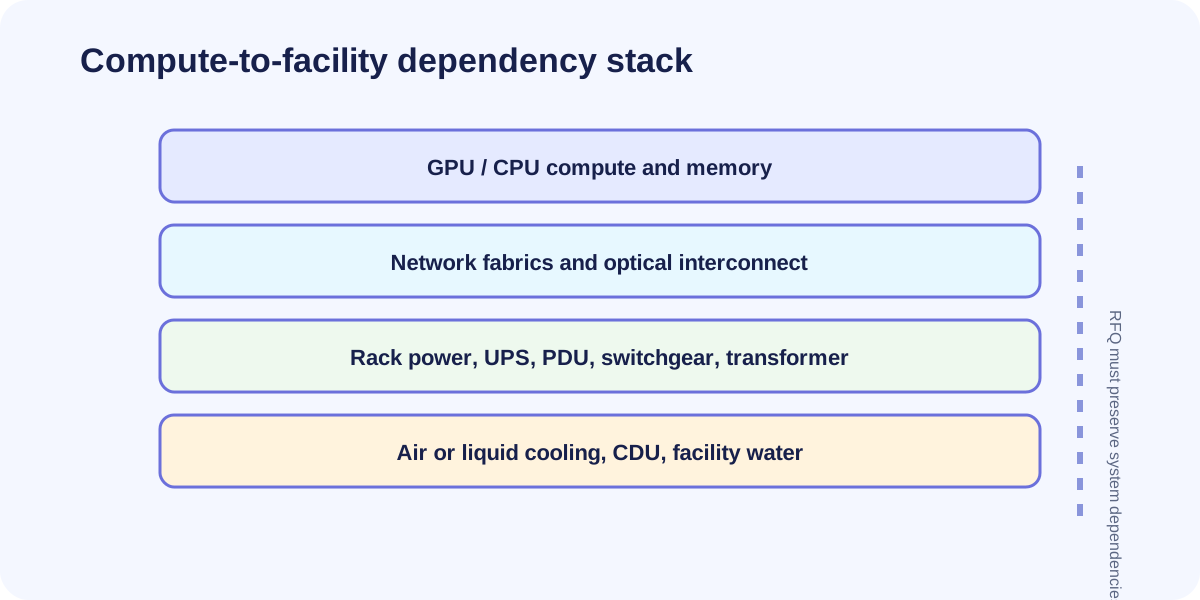
- Coordinate compute, power, racks, networking, and cooling as one infrastructure RFQ.