Guide · Procurement guide
How to Evaluate and Approve Component Alternates
Reviewed by Enzo Parilli · Updated 2026-08-02 · Editorial policy
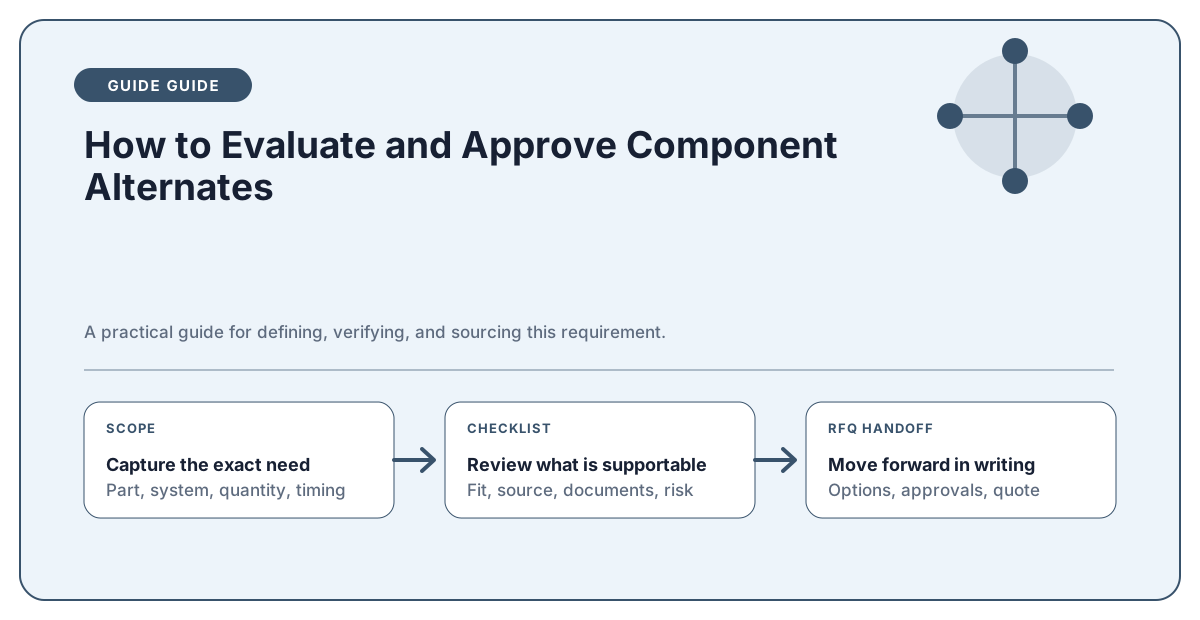
Direct answer
What does How to Evaluate and Approve Component Alternates | Max Semiconductors mean for a buyer or engineering team?
How to Evaluate and Approve Component Alternates is a informational / commercial investigation resource for engineers, procurement and facilities. It frames how to evaluate and approve component alternates as a requirement to verify—identity, technical fit, source route, documentation, lifecycle, packaging, timing, and commercial conditions—rather than as a claim of inventory, authorization, certification, price, or guaranteed availability.
The direct procurement answer
How to Evaluate and Approve Component Alternates is a informational / commercial investigation resource for engineers, procurement and facilities. It frames how to evaluate and approve component alternates as a requirement to verify—identity, technical fit, source route, documentation, lifecycle, packaging, timing, and commercial conditions—rather than as a claim of inventory, authorization, certification, price, or guaranteed availability.
A guide should turn a broad procurement question into a reviewable sequence with evidence checkpoints and an RFQ handoff.
- Primary search question: how to evaluate and approve component alternates.
- Designed for Engineers, procurement and facilities.
- Funnel context: Awareness / consideration.
What this page covers
This guide covers Direct answer, definitions, workflow, requirements, risks, decision table. The sections are tailored to How to Evaluate and Approve Component Alternates | Max Semiconductors, so the page can be used on its own without relying on a label or assumption.
Related language includes guide, checklist, sourcing, procurement. These terms are supporting context, not separate claims of inventory, compatibility, or market position.
- Identify the exact object, system, process, or decision being researched.
- Separate educational guidance from offer-specific evidence.
- Record assumptions so engineering, procurement, quality, and operations can review the same requirement.
Evidence and source-route controls
The evidence requirement for this topic is Primary manufacturer, government, standards and trade sources. A source route should be described by what can be documented for the specific offer—not by a directory label, a manufacturer name, or an assumption about authorization.
Important caution: Generic AI text, unsupported engineering or stale claims. Buyers should request the evidence that matters to their application and approval process before committing.
- Confirm identity, revision, package, grade, quantity, and required date.
- Ask what source, lot, date-code, packaging, inspection, and documentation evidence is available.
- Require engineering or quality approval for alternates, substitutions, lifecycle decisions, and regulated use.
A practical next step
The recommended action is Use checklist in an RFQ. A useful request contains enough detail for the sourcing desk to separate a known requirement from an assumption and to return conditions in writing.
For a component or BOM, include exact MPNs, manufacturers, quantities, packaging, date-code limits, destination, required date, alternates policy, and any traceability or compliance requirement. For infrastructure, include capacity, interface, environment, installation constraints, maintenance assumptions, and the responsible engineering approver.
- Start with the exact requirement or upload a structured BOM.
- Use the related research links below to close terminology or system-level gaps.
- Treat price, availability, lead time, authorization, certification, and compatibility as quote- or evidence-specific conditions.
Frequently asked questions
What does How to Evaluate and Approve Component Alternates | Max Semiconductors mean for a buyer or engineering team?
How to Evaluate and Approve Component Alternates is a informational / commercial investigation resource for engineers, procurement and facilities. It frames how to evaluate and approve component alternates as a requirement to verify—identity, technical fit, source route, documentation, lifecycle, packaging, timing, and commercial conditions—rather than as a claim of inventory, authorization, certification, price, or guaranteed availability.
Who should use this guide page?
Engineers, procurement and facilities. The page is designed for a reader who needs a documented decision path, not an assumption that a public taxonomy page proves current supply.
What should be verified before an RFQ or purchase decision?
Verify the exact requirement, MPN or system specification, quantity, required date, packaging or configuration, source route, documentation, lifecycle, destination, and any engineering or compliance approval needed for how to evaluate and approve component alternates.
Research reference: Max Semiconductors Homepage ↗ (Max Semiconductors). This reference supports the research context stated on the page; it does not establish Max authorization, inventory, price, or a current offer.